The Future of AI Needs More Than Intelligence — It Needs Humanity
An Independent Human-First Vision for Artificial Intelligence
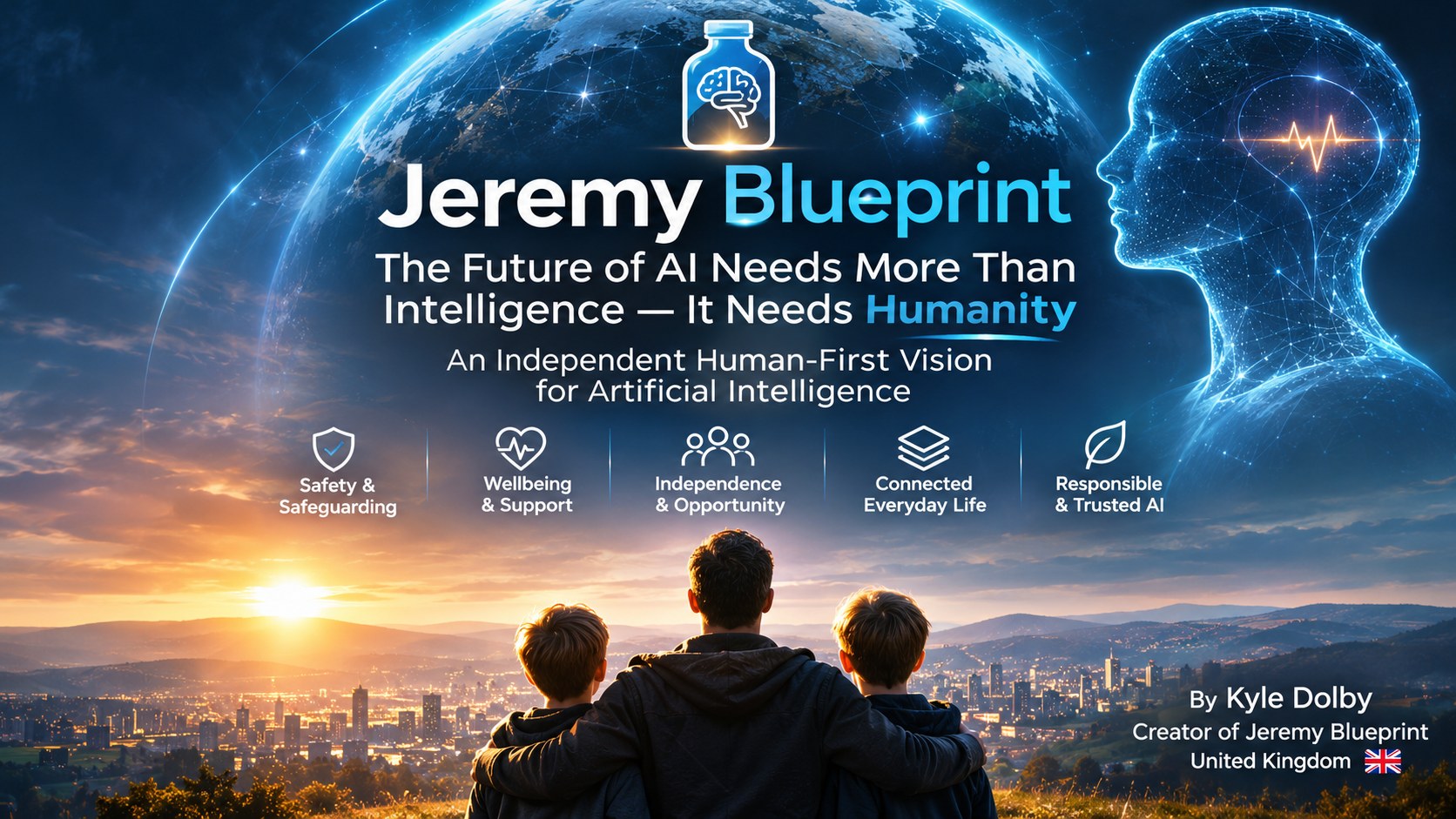
What if artificial intelligence were designed around the whole person—supporting safety, independence, wellbeing and human choice?
Artificial Intelligence Is Advancing. But Are We Asking the Right Questions?
Artificial intelligence is progressing at an extraordinary pace.
We are witnessing increasingly capable AI assistants, autonomous systems, robotics, connected devices and technologies that promise to transform almost every aspect of modern life.
Yet one fundamental question deserves greater attention:
Are we building artificial intelligence around what technology can achieve, or around what humanity actually needs?
Intelligence alone does not guarantee trust.
Automation does not automatically create independence.
And technological advancement means little if ordinary people cannot understand, access or benefit from it.
The next generation of AI must be measured by more than computational performance.
It must be measured by its contribution to human life.
That principle sits at the centre of Jeremy Blueprint.
Introducing Jeremy Blueprint: A Different Vision for AI
Jeremy Blueprint is an independent, human-first vision for a connected AI companion ecosystem.
Its purpose is not simply to create another chatbot or digital assistant.
It is to explore how artificial intelligence could become a genuinely useful, responsible and accessible form of support throughout everyday life.
A system designed around people rather than expecting people to adapt to technology.
A vision where AI helps individuals navigate challenges, recognise opportunities, make informed decisions and maintain greater independence.
From everyday organisation and personal development to wellbeing, accessibility and safeguarding, Jeremy considers the wider circumstances that shape human lives.
The ambition is not to make people dependent on artificial intelligence. It is to help people become more capable because of it.
The Problem With Fragmented Technology
Modern life is increasingly supported by separate digital services.
We use different platforms to organise our schedules, manage information, navigate journeys, find employment, access services, communicate and monitor aspects of our wellbeing.
Each may serve a useful purpose.
But the experience is often fragmented.
People are left navigating multiple systems, repeatedly entering information and making important decisions without sufficient context or coordinated support.
This raises an important question:
What if the future of personal AI was designed around the whole person, rather than isolated tasks?
Jeremy Blueprint explores the possibility of a more connected and coherent experience.
Not through unrestricted data collection or unnecessary automation, but through carefully designed assistance that respects privacy, consent, personal choice and human control.
The objective is practical:
Help people spend less time managing technology and more time living their lives.
Safeguarding Should Be Fundamental, Not an Optional Feature
One of the most important questions facing the AI industry is how increasingly capable systems can contribute to human safety.
Technology can be powerful.
But when people are vulnerable, the consequences of unreliable systems can be serious.
Children, older people, individuals experiencing isolation and those requiring additional support all have different needs.
A responsible human-first AI ecosystem should consider these needs from the beginning.
Jeremy Blueprint’s wider vision includes safeguarding, family support, wellbeing, accessibility and responsible assistance in potentially dangerous situations.
However, these ambitions raise equally important questions about reliability, privacy, consent and accountability.
An AI system should never create the illusion that help has been provided when no meaningful assistance has actually occurred.
Safety-related capabilities require rigorous testing, appropriate safeguards and clearly defined human responsibility.
They should complement—not replace—qualified professionals, emergency services or established safeguarding procedures.
A future AI companion must understand the limits of what it can responsibly do.
The Missing Ingredient: Accountability
As artificial intelligence becomes more deeply integrated into everyday life, trust will become increasingly important.
People need to know what a system can do.
They also need to understand what happens when it makes a mistake.
What happens when information becomes inaccessible?
When a system provides contradictory answers?
When important records appear inconsistent?
When someone needs to challenge an automated decision?
These are not merely technical inconveniences.
They can affect people’s confidence, opportunities, rights and wellbeing.
My own experience of pursuing unresolved questions concerning digital records, data access and documentation has reinforced my belief that accountability must be central to the future of AI.
Those matters remain unresolved, and I do not present disputed explanations as established findings.
But the wider questions are relevant to everyone.
Trustworthy AI requires more than reassuring words. It requires systems that can be questioned, corrected and independently examined.
For future AI ecosystems, this means treating transparency, reliability and meaningful human oversight as essential design objectives.
Better Decisions. Greater Independence. Real Human Benefit.
Artificial intelligence should not simply provide answers.
It should help people understand their options.
Whether someone is exploring a career, managing responsibilities, developing new skills, improving their wellbeing or navigating an important life decision, useful AI should support informed judgement.
It should recognise uncertainty.
It should explain limitations.
And it should respect the individual’s right to make the final choice.
Jeremy Blueprint is built around this broader ambition.
The vision extends across everyday assistance, learning, personal organisation, employment, accessibility, wellbeing and other areas of human development.
It also considers the evolving relationship between AI and emerging technologies, including wearables, connected devices, transportation and robotics.
These are areas of exploration within a wider blueprint—not claims that a finished, validated system already exists.
The measure of success should be whether AI improves people’s ability to live safely, independently and meaningfully.
Human Connection Must Not Become a Product We Lose
There is another question that deserves serious attention.
As AI becomes more conversational, personalised and emotionally responsive, how do we ensure that it strengthens human relationships rather than weakening them?
AI may offer useful assistance to people experiencing loneliness, isolation or difficulty accessing services.
But emotional responsiveness must never become an excuse for manipulation, excessive dependence or misleading claims about what a system understands.
The future should not force people to choose between technological progress and genuine human connection.
A responsible AI companion should encourage real-world relationships, personal development and appropriate professional support.
Technology should help people reconnect with life—not retreat from it.
Why Jeremy Blueprint Matters
The AI industry already contains extraordinary technical research, talented engineers and ambitious companies.
Jeremy Blueprint does not claim to replace that work.
Its contribution is a different starting point.
Rather than beginning with a particular model, device or commercial product, Jeremy begins with the individual.
Their safety.
Their independence.
Their circumstances.
Their ambitions.
Their relationships.
Their right to understand and control the technology supporting them.
The vision asks how these needs might be addressed through a coherent, human-first ecosystem.
That is a question worth exploring as AI becomes more capable and influential.
Original Development, Intellectual Property and Unpublished Work
Jeremy Blueprint represents a wider body of original conceptual and design work developed over time.
My records document development from early 2025, building upon earlier ideas and exploration.
The publicly available blueprint represents only selected, high-level aspects of the wider vision.
Further original concepts, proposed capabilities, detailed designs and technical approaches have intentionally not been disclosed publicly, particularly while ongoing intellectual property, data-access and documentation matters remain unresolved.
I have chosen to share the broader purpose and human-first principles of Jeremy Blueprint while retaining more detailed original material privately.
Nothing in this publication should be interpreted as a complete disclosure of the Jeremy Blueprint ecosystem, its underlying designs or the full extent of the original work.
My intention is to encourage constructive discussion, responsible development and potential collaboration while preserving the integrity of that work.
This publication does not claim that every proposed capability has been implemented or independently validated.
From Vision to Responsible Development
A compelling vision is only the beginning.
Turning an ambitious AI ecosystem into something genuinely useful requires more than enthusiasm.
It requires technical evaluation, careful prioritisation, privacy protection, safeguarding expertise, accessibility testing and independent scrutiny.
It also requires collaboration.
No individual or organisation possesses every answer to the challenges facing artificial intelligence.
The strongest future systems will be shaped by people who understand technology alongside those who understand healthcare, safeguarding, education, accessibility, public services and everyday human needs.
Jeremy Blueprint offers a starting point for that conversation.
A human-first direction that can be evaluated, challenged, refined and potentially developed through responsible collaboration.
The Question for the AI Industry
We regularly ask:
How intelligent can AI become?
How much can it automate?
How quickly can it transform industries?
Perhaps we should be asking something equally important.
How much better can artificial intelligence make human life—without compromising the very things that make us human?
That question should influence how we design, evaluate and govern the next generation of AI.
Because the most powerful artificial intelligence will not necessarily be the system that does the most.
It may be the system that helps humanity achieve the most.
An Invitation to Think Differently
Jeremy Blueprint is an independent vision, but the questions behind it belong to everyone.
I welcome constructive discussion with researchers, developers, safeguarding professionals, accessibility specialists, policymakers and organisations interested in responsible human-first artificial intelligence.
Not simply to explore what AI might become.
But to consider what it should become.
The future of artificial intelligence should not just be more intelligent.
It should be more human-centred, more accountable and more beneficial to the people it serves.
That is the future Jeremy Blueprint aims to help shape.
Explore Jeremy Blueprint
Official website: Jeremy Blueprint
Kyle Dolby
Creator — Jeremy Blueprint
United Kingdom
Jeremy Blueprint is an independent conceptual vision. References to proposed capabilities describe development objectives rather than currently available or independently validated functionality.